Guyana and Jamaica sign tourism pact. What happens next will determine its value
The MOU covers air connectivity, investment and hospitality training, but no specific projects, timelines or funding commitments have been announced.


The MOU covers air connectivity, investment and hospitality training, but no specific projects, timelines or funding commitments have been announced.
GEORGETOWN — Guyana and Jamaica have signed a memorandum of understanding to cooperate on tourism investment, air connectivity, hospitality training and sustainable development, creating a framework for closer ties between two Caribbean destinations at different stages of tourism development.
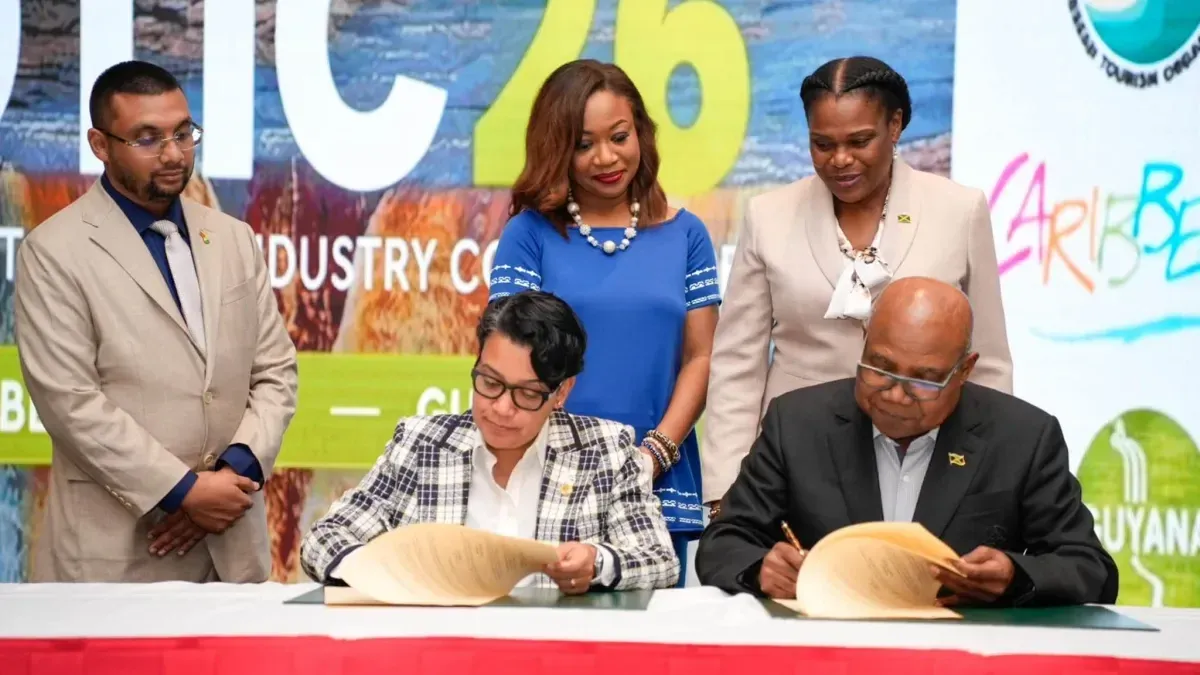
Minister of Tourism, Industry and Commerce Susan Rodrigues and Jamaica’s Tourism Minister Edmund Bartlett signed the agreement on October 9 at the Atlantic Suites by Hyatt during the Caribbean Tourism Organization’s State of the Tourism Industry Conference, SOTIC 2026.
The signing was witnessed by Jamaica’s Tourism Ministry Permanent Secretary Jennifer Griffith, Guyana Tourism Authority Director Kamrul Baksh and CTO Secretary-General and CEO Dona Regis-Prosper.
The agreement identifies areas for cooperation.
What it does not yet provide publicly is a list of projects, implementation dates, financing commitments or new air services.
Those details will determine how much practical value the agreement creates for Guyanese workers, businesses and travellers.
What the agreement covers
According to the official announcement, Guyana and Jamaica intend to cooperate on:
• tourism investment;
• air connectivity and travel between the two destinations;
• education and hospitality training;
• sustainable tourism development;
• tourism resilience;
• knowledge exchange;
• and stronger links between tourism stakeholders.
The MOU creates the basis for collaboration between governments, tourism agencies, training institutions and private businesses.
It should not, however, be read as confirmation that new flights, investment projects or training programmes have already been secured.
Why it matters for Guyana
The agreement comes as Guyana’s tourism sector continues to expand.
The country recorded 453,489 visitor arrivals in 2025, the highest annual total on record and a 22 per cent increase over 2024.
Growth has continued in 2026.
Rodrigues reported 360,623 visitor arrivals during the first nine months of the year, while the government is targeting more than 500,000 arrivals by year-end.
That growth increases demand not only for hotel rooms and flights, but also for trained workers, transport services, tour operators, guides, restaurants, suppliers and other businesses connected to tourism.
Jamaica’s longer-established tourism industry makes hospitality training, destination management and workforce development particularly relevant areas of cooperation.
Two different tourism markets
Guyana and Jamaica offer very different tourism products.
Guyana’s visitor economy is strongly associated with nature, wildlife, Indigenous heritage and community-based experiences.
Jamaica has a mature resort and hospitality industry with decades of experience in mass tourism, training and international marketing.
Bartlett said the partnership could strengthen Caribbean tourism integration and multi-destination tourism, describing Guyana as an “emerging destination” that adds forests, valleys and natural heritage to the regional tourism product.
Rodrigues has used different language to describe Guyana’s current position.
In September, she said Guyana was “no longer an emerging destination” but one that had become competitive and sustainable.
Both statements point to the same underlying shift: Guyana is trying to move from tourism growth into a more established regional position.
The MOU now creates a framework through which that relationship with Jamaica can be tested in practice.
The air connectivity question
Air connectivity is one of the most visible areas covered by the agreement.
Stronger links between Caribbean destinations could support multi-destination travel and make it easier for visitors to include more than one country in a single trip.
The public announcement does not identify a new Georgetown–Kingston route, additional frequencies or commitments from any airline.
Any change in connectivity will therefore depend on what governments, airports, airlines and tourism operators develop after the agreement.
Where could businesses benefit?
The official announcement refers to investment, stronger stakeholder engagement and opportunities for collaboration.
For Guyanese businesses, the practical questions are more specific.
Will tour operators be included in regional packages?
Will hotels, lodges and community-based tourism businesses gain access to new markets?
Will hospitality workers receive training or exchange opportunities?
Will local suppliers be able to participate in investment or procurement opportunities created through the partnership?
Those details have not yet been announced.
What to watch next
The agreement is a framework.
Its value can be measured through several concrete developments:
1. Implementation plan: whether the two governments publish timelines and responsible agencies.
2. Training: which institutions will provide hospitality or professional development programmes and who will be eligible.
3. Air connectivity: whether airlines announce new routes, additional frequencies or other regional connections.
4. Business access: how Guyanese tour operators, hotels, guides and community enterprises will participate.
5. Investment: whether the partnership produces specific tourism projects or financing opportunities.
6. Results: what indicators the two countries will use to measure whether the agreement is working.
The MOU gives Guyana and Jamaica a formal structure for deeper tourism cooperation.
The next stage is implementation.
For Guyanese businesses and workers, the real measure will be whether that framework produces opportunities they can actually access.