OpenAI claims three major scientific advances. Can independent experts verify them?
OpenAI claims major advances in mathematics, computing and physics. But what can independent scientists actually verify?

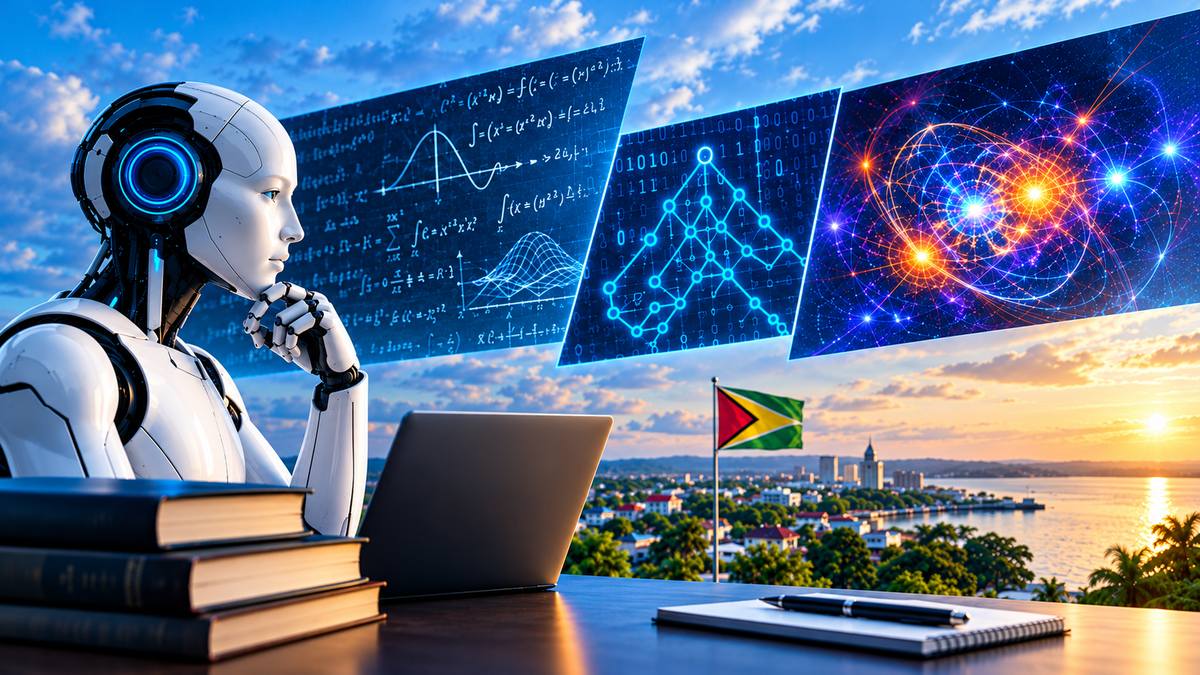
Artificial intelligence systems may have produced answers to some of science's most difficult mathematical problems. But researchers still face a fundamental question: how should discoveries made by AI be independently examined, understood and accepted?
OpenAI announced on October 26 that its models had generated results addressing long-standing questions in mathematics, computer science and theoretical physics. The company described the AI-generated manuscripts as raw research findings and invited external experts to help examine and explain them.
Some supporting material has been released publicly. Other work remains accessible only to a selected review group, prompting criticism from mathematicians who argue that scrutiny should be open to the wider community.
Three claims, three scientific fields
Mathematics: how waves behave
OpenAI says its models have proved the local smoothing conjecture in every dimension. First proposed by mathematician Christopher Sogge in 1991, the conjecture concerns how waves concentrate and how extreme focusing changes over time.
According to OpenAI, the proof would also resolve the Kakeya conjecture and a related restriction conjecture associated with mathematician Elias Stein across all dimensions.
The claim is particularly significant because mathematicians Hong Wang and Joshua Zahl proved the three-dimensional Kakeya conjecture in 2025, a breakthrough among the contributions recognised when Wang received a Fields Medal in 2026. If OpenAI's broader result withstands scrutiny, that proof would form part of a more general mathematical picture.
The company has released both a written account of the proof and a version formalised in the Lean proof assistant.
Computer science: a challenge to computing limits
OpenAI also says its models have disproved the Exponential Time Hypothesis (ETH), a widely used assumption about how difficult certain computational problems are to solve.
The claim concerns an algorithm for a problem known as 3-SAT, which involves determining whether a collection of logical conditions can all be satisfied. If upheld, the finding would affect theoretical research built on ETH, which has been used in hundreds of academic papers. It does not mean ordinary computers have become dramatically faster, nor that current encryption systems have been broken.
OpenAI has released its manuscript and Lean formalisation and asked a review group led by computer scientists Russell Impagliazzo, Ramamohan Paturi and Ryan Williams to help assess the result.
Physics: the mathematical foundations of matter
The third claim concerns quantum field theory, the framework used to describe fundamental particles and their interactions. OpenAI says its models produced existence proofs for certain interacting quantum field theories in four dimensions, including pure Yang–Mills theory and quantum chromodynamics, which describes the strong nuclear force involving quarks and gluons.
The Yang–Mills question forms part of a Millennium Prize Problem established by the Clay Mathematics Institute, but the full problem also requires proving a property known as the mass gap. OpenAI has not claimed to resolve that requirement and has said it will not seek the US$1 million prize.
Nobel Prize-winning physicist David Gross is leading a group of experts examining the physics work. Unlike the mathematics and computer science material, the underlying physics outputs have not been released. OpenAI says the review group chose to develop its own explanation of the results before wider publication.
The dispute over access
On October 26, the Advisory Group on Mathematics and Artificial Intelligence (AGMAI), which includes mathematicians associated with the Institute for Advanced Study, called on OpenAI to release its Yang–Mills outputs without delay. If formal verification is complete, the group said, "there is no scientific reason for delaying the release any further."
OpenAI has acknowledged that choosing the first experts to review AI-generated research gives those researchers earlier access and can influence who participates in developing the results.
Anthropic reports a parallel result
Shortly after OpenAI's announcement, rival AI company Anthropic published research attributed to its Claude model, reporting a separate algorithm that would also refute the Exponential Time Hypothesis.
According to Anthropic, an internal Claude research model found the core algorithm on October 16 without human input. The company published a formalisation in Lean and acknowledges OpenAI's similar claim.
The two laboratories' claims have attracted attention, but neither has yet received comprehensive independent scientific scrutiny. Reaching similar conclusions does not, by itself, validate either proof.
What does formal verification prove?
Lean is software that checks whether the steps of a mathematical argument follow logically from stated definitions and assumptions. That makes it a valuable safeguard against gaps in reasoning.
But a computer-checked proof is not a substitute for scientific understanding. Researchers must still examine whether the formal definitions match the original problem, whether the assumptions are appropriate and what conclusions legitimately follow.
Why this matters for Guyana
The research offers no immediate practical application for Guyana or the wider Caribbean. Its significance is broader: AI systems are increasingly being used not only to organise scientific knowledge but to generate arguments that researchers must evaluate. For countries building scientific and technological capacity, using advanced AI tools is one challenge; having the expertise to assess what they produce is another.
What happens next?
Independent specialists will continue examining the published mathematics and computing results, while the physics review group decides how and when to make its assessment and supporting material accessible. Until then, the announcements remain potentially significant scientific claims whose validity and wider implications require independent assessment.